Virtual Reality as a Research Instrument
The VR headset market presents a wide range of trade-offs between resolution, field of view, display technology, documentation, and price. It is not feasible for full-time scientists to serve as technology market analysts as well. Nor can it be expected that every research field interested in simulating real-world scenarios will possess a deep understanding of how individual technical specifications influence perceptual outcomes. Likewise, it is unrealistic to assume that all potential scientific users of VR have the time to navigate marketing claims and identify the most suitable device for their use case. We consider it an inefficient use of resources that the current lack of structured documentation and guidance forces each research group to conduct this market analysis independently.
Our work investigates the effects of individual specifications - such as resolution, field of view, and dependence on external hardware - on immersion and perception in VR. We conducted a thematic review of the literature on this subject. In parallel, we scraped publicly available databases of VR headsets, resulting in a dynamically evolving dataset comprising all available devices with 60+ specifications each. Based on insights from the review, we identified the most relevant specifications, which could be verified using manufacturer-provided materials for most of the devices. Additionally, we collected “soft” data where available, including factors such as device openness, quality of documentation, potential data security concerns, and community impact.
Next Steps
For our own research, the next step is to select suitable devices and conduct perception studies that isolate single specifications as experimental treatments.
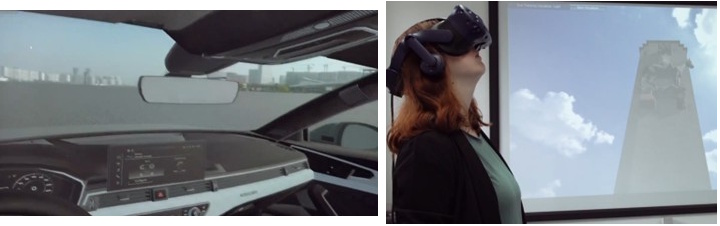
Very different requirements for different research questions: left, fast processing of dynamically changing stimuli in our automotive research, right, ultra-high quality rendering for our culturally oriented project with the Unesco World Heritage „Bamberger Reiter“ in Bamberg.
For the broader scientific community, we are working toward releasing both the dataset and our internal viewer in a public alpha version. We also aim to develop a concise buyer’s guide for using VR as a research instrument from a perception psychology perspective, highlighting a curated selection of notable VR solutions.